
What Does Children's Dentistry Include at Pasadena Dental Office and Orthodontics?
Children's dentistry at Pasadena Dental Office and Orthodontics includes routine exams, cleanings and fluoride treatment. It also includes cavity treatment and dental sealants for kids of every age. Dr. Solomon Heifets and hygienist Bianca provide this care as general dentists, not as pediatric specialists. They teach parents and children the home habits that protect growing teeth. The practice treats children alongside parents and grandparents in the same family dental home. Oral health in the primary teeth years sets the stage for permanent teeth later. That is why the practice treats routine oral care for children as seriously as it treats adult patients. No provider at this office holds a board certification in pediatric dentistry. The practice does not advertise itself as a specialty pedodontics office. Pedodontics, also spelled paedodontics, is simply the formal name for children's dentistry. Instead, families get a gentler version of the same American Dental Association (ADA)-recognized preventive care every patient receives. That means regular checkups, patient education and a consistent team who already knows your child. Consistency matters most for anxious or first-time patients. A familiar hygienist and dentist reduce the uncertainty that drives dental phobias in young children. Establishing this kind of dental home early gives your child one steady place for care as they grow. There is no need for a new office and a new face every time something comes up.
When Should Your Child Have Their First Dental Visit?
Your child should have their first dental visit at the eruption of their first tooth. That first visit should come no later than 12 months old. The American Academy of Pediatric Dentistry's Periodicity of Examination policy sets this "age one visit" standard.[1] As reported by that policy, the American Academy of Pediatrics backs the same standard. An early visit lets the dentist check eruption timing and spot early decay. It also lets the dentist coach parents on brushing before problems start. The visit introduces your child to the dental chair while the stakes are low. A calm first visit at one year old builds a habit. That habit makes every later visit easier.
What Happens at Your Child's First Visit
The first visit at Pasadena Dental Office and Orthodontics uses a simple tell-show-do approach. The doctor or hygienist tells your child what a tool does, using child-friendly terminology instead of clinical words. They show the tool on a finger or a stuffed animal first. Only then do they do the actual step in your child's mouth. A typical first visit includes:
- A gentle knee-to-knee or lap exam for an infant or young toddler
- A count and check of erupted teeth and a look at upcoming eruption patterns
- A light cleaning, known clinically as prophylaxis, if teeth are already present
- Guidance for parents on brushing, baby-bottle habits and teething
Parents stay close throughout. The pace follows the child rather than the clock. The team avoids scary words like drill or needle. Instead, they describe each tool in simple, friendly language. Nothing feels threatening before a child even sees it.
Why the "Age-One Visit" Matters Even Before All the Teeth Are In
The age-one visit matters because waiting delays prevention past the point it helps most. A common myth holds that a child only needs a dentist once most baby teeth have erupted. Some parents call this a "two-year rule." That framing is inaccurate. Decay can start as soon as the first tooth appears. Early exams catch problems while treatment is still simple. Many families wait years past that window. Starting at age one closes that gap for your own child well before kindergarten. An early, positive visit also lowers the odds of the dental phobias that can follow a child into adulthood. The team can monitor growth and development from the very first appointment, rather than starting from scratch later.
Dental Care at Every Age: From First Tooth to Teen Years
Dental care at every age changes as your child's mouth develops, from the first tooth through the teen years. As per the American Academy of Pediatric Dentistry, tooth decay is the most common chronic disease of childhood.[2] It is more common than asthma, which is why age-appropriate prevention matters at each stage. A toddler needs different coaching than a school-age child with new permanent molars. A teenager needs orthodontic screening on top of routine cleanings. Pasadena Dental Office and Orthodontics follows your child through every one of these stages. Care never gets handed off at a fixed age.
| Age Range | Recommended Checkup Frequency | Main Focus |
|---|---|---|
| First tooth to age 3 | Twice yearly once teeth erupt | Eruption tracking and early habit coaching |
| Ages 3 to 6 | Twice yearly | Routine cleanings and first sealants |
| Ages 6 to 12 | Twice yearly | Permanent molar protection and mouth guards |
| Teens | Twice yearly, plus an orthodontic screening | Bite and alignment checkpoints |
Infants and Toddlers: First Tooth to Age 3
Infants and toddlers need their first cleanings as soon as teeth erupt. That is usually starting around six months old. The dentist tracks eruption order against typical timelines and flags anything unusual early. Parents learn how to wipe gums before teeth appear. Once teeth come in, parents brush with a rice-grain amount of fluoride toothpaste. Baby bottle and pacifier habits get gentle, judgment-free coaching rather than a hard deadline to quit.
Preschool and Early Elementary: Ages 3 to 6
Preschool and early elementary children settle into a twice-yearly cleaning routine during this stage. Diet and snacking patterns become a bigger factor in cavity risk as kids start eating more on their own. This is also the age when first molars typically erupt. The practice most often places dental sealants on those new molars, covered in detail below. Dentists use this window to build a child's own home hygiene routine around brushing and flossing. The routine becomes the child's own, not just a parent's.
School-Age Kids: Ages 6 to 12
School-age kids start losing baby teeth and growing in permanent molars during this stage. That often starts with the first permanent molars around age six. Sealants placed on these new molars protect them during the years kids are most likely to skip a thorough brushing. Sports and snacking both increase during this stage. Mouth guards and diet coaching both become more relevant here, covered further below.
Teens and Orthodontic Checkpoints
Teens benefit from an orthodontic screening alongside their regular cleanings. Adolescence is when crowding, spacing and a bad bite, known clinically as malocclusion, typically become visible. An early orthodontic evaluation can catch one of these issues sooner. That often means simpler orthodontic treatment later. Pasadena Dental Office and Orthodontics can evaluate whether your teen needs a referral. That can include the practice's own teeth straightening and orthodontics services. Routine cleanings continue through this stage even if no orthodontic treatment is needed yet.
Dental Sealants: A Simple Way to Prevent Cavities in Growing Teeth
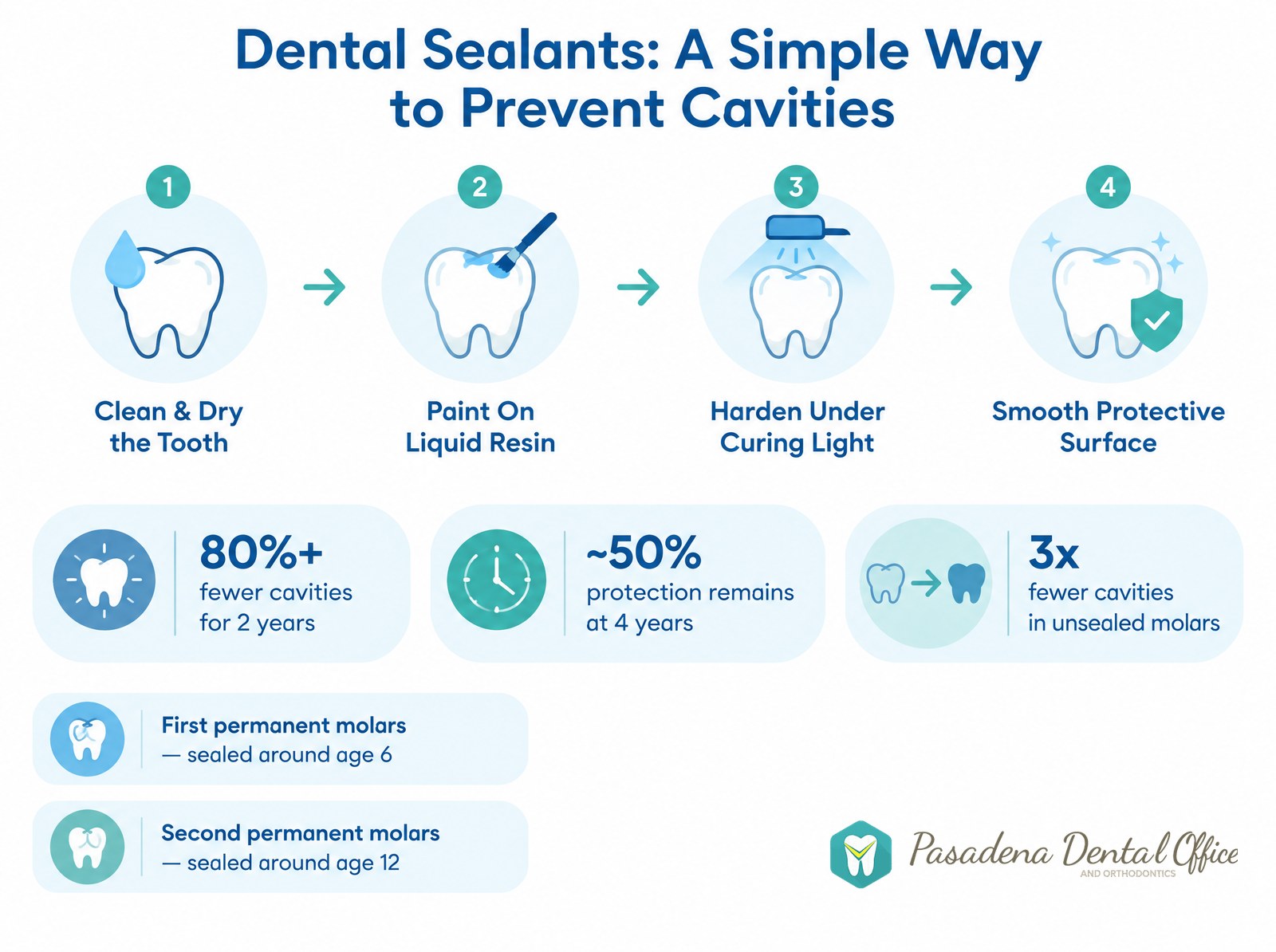
Dental sealants are a simple way to prevent cavities in growing teeth. They seal off the deep grooves where food and bacteria collect. The practice's own homepage already lists dental sealants as a service it offers. This page is where that service gets explained in full. Sealants are a thin, protective coating painted onto the chewing surfaces of back teeth. They are not a filling. They do not require any drilling or numbing to place.
How Sealants Work
Sealants work by filling in the narrow grooves and pits on a molar's chewing surface. A toothbrush bristle cannot easily reach those grooves on its own. The dentist cleans and dries the tooth, then paints on a liquid resin. That resin hardens under a curing light. Once set, the smooth sealant surface is far easier to keep clean than the natural grooves underneath. As cited by the CDC, sealants prevent more than 80 percent of cavities in treated molars for two years.[3] That protection tapers to about 50 percent by four years. Children without sealants get nearly three times as many cavities in their first molars.
When Kids Typically Get Sealants
| Typical Age | Tooth Sealed | Why This Timing |
|---|---|---|
| Around age 6 | First permanent molars | Sealed soon after eruption, before deep grooves trap plaque |
| Around age 12 | Second permanent molars | Sealed as soon as the tooth fully erupts |
| Any age | Any deeply grooved molar or premolar | Applied whenever a tooth's shape puts it at higher risk |
Cavity Prevention, Fluoride and Everyday Habits That Protect Your Child's Smile
Cavity prevention, fluoride and everyday habits work together to protect your child's smile between visits. A meaningful share of children already have a cavity by elementary school. Often a parent does not notice anything wrong beforehand. Home habits and in-office fluoride both reduce that risk, and neither one replaces the other. A healthy, cavity-free smile also supports a child's own self-esteem. Kids start noticing their own smile in photos and at school as they get older.
Parents can watch for a few early warning signs between visits:
- White or brown spots appearing on a tooth's surface
- New sensitivity to sweets, cold or hot foods
- A visible pit or hole in a tooth
- A child favoring one side of the mouth while chewing
The sections below separate what happens at home from what happens in the dental chair.
Brushing, Flossing and Diet at Home
Brushing, flossing and diet at home form the daily foundation of cavity prevention. Age-appropriate brushing starts with a parent's help and a rice-grain amount of fluoride toothpaste. That amount grows to pea-sized as a child gets older. Flossing becomes relevant as soon as two teeth touch each other, usually sometime in the preschool years. Good chewing habits help, but sugary drinks and frequent snacking between meals raise cavity risk the most. An occasional treat after a meal is lower risk than sipping or snacking all day. All-day snacking keeps sugar in contact with teeth for longer. A short daily routine built early tends to stick through the school-age years without a fight.
Topical Fluoride at the Dental Office
Topical fluoride at the dental office strengthens enamel in a way home toothpaste cannot match. The hygienist applies a varnish directly to the teeth after a cleaning. It hardens on contact with saliva. Most children get this varnish at their regular preventive visits, roughly twice a year. It is a quick, painless step added onto an existing cleaning appointment. It is not a separate visit on its own. Combined with sealants and a solid home routine, topical fluoride rounds out the practice's three main tools against decay.
Helping Your Child Feel Calm and Comfortable at the Dentist
Helping your child feel calm and comfortable at the dentist starts with pacing every visit to their comfort level. The team uses local anesthesia for any procedure that needs numbing. They pair it with behavior-guidance techniques rather than sedation. Those techniques include:
- Tell-show-do narration before any new tool touches a child's mouth
- Positive reinforcement and praise for cooperative behavior
- Parent presence in the room throughout the visit
- A pace that slows down or pauses when a child needs a moment
This practice does not offer nitrous oxide or sedation dentistry for children. Families who want that specific option should ask the front desk about a referral before booking. What the team does offer is patience and a familiar hygienist and dentist. They also break a procedure into smaller steps for an anxious child. Much of this approach draws on basic child psychology. A predictable routine and a familiar face lower a child's fear more than any single piece of equipment does.
Dental Care for Kids With Special Needs or Extra Anxiety
Dental care for kids with special needs or extra anxiety follows the same unhurried approach. The team still uses tell-show-do, adjusted to each child. A child with autism, cerebral palsy or sensory sensitivities often benefits from a slower warm-up period. The same is true for a child with a diagnosed anxiety disorder. The team welcomes a parent's own input on what has worked, or not worked, before. This is a patient, general-dentistry approach to special-needs care. It is not a claim of specialized pediatric-sedation credentialing.
Gentle, Experienced Care From Our Pasadena Dental Team
Gentle, experienced care from our Pasadena dental team starts with Dr. Solomon Heifets, DDS, and hygienist Bianca. Dr. Heifets is the practice's primary dentist. He sees children as part of his general family dentistry. Bianca holds a bachelor's degree in biology and is laser-dentistry certified. She is bilingual in English and Spanish. Both are general-dentistry and hygiene providers, not board-certified pediatric dental specialists. Neither holds a Diplomate credential from the American Board of Pediatric Dentistry. The practice is upfront about that rather than implying otherwise. What families get instead is a team that already knows your child by the second or third visit. The practice treats children as part of its everyday family dentistry, not as a separate specialty track.
The practice backs that team with real equipment and access:
"Dr. Solomon is wonderful. Carmen is a great dental assistant. Susan and so friendly and fun. Carmen and Monica are great too."
Common Childhood Dental Concerns We Treat
Common childhood dental concerns treated here include baby-tooth cavities, thumb-sucking and sports injuries. Each one is routine. Each one responds better to an early, calm conversation than to a wait-and-see approach. None of these require a pediatric specialist to manage well. They are standard parts of general family dentistry for kids. The three sections below cover what a parent can expect for each.
| Concern | Typical Age Range | What the Practice Does |
|---|---|---|
| Cavities in baby teeth | 2 and up | Fillings sized for a baby tooth |
| Thumb-sucking and pacifier habits | Infant through preschool | Gentle, judgment-free coaching timed to the habit, not a fixed deadline |
| Sports-related tooth injuries | School age and teen | Mouth guard fitting and same-visit evaluation after an injury |
Cavities and Tooth Decay in Baby Teeth
Cavities and tooth decay in baby teeth still matter, even though those teeth eventually fall out. A decayed baby tooth can hold space for the permanent tooth growing underneath it. Losing that space early can crowd the permanent tooth later. An untreated cavity can also spread infection to the gum and the developing adult tooth below. A deep cavity that reaches the tooth's nerve may need pulp therapy instead. The idea is similar to a root canal. That treatment can save the tooth rather than remove it early. In pediatric dentistry generally, a device called a space maintainer is sometimes used to hold a lost tooth's space open until the adult tooth is ready to erupt. Evidence on how well these devices work is more limited than many parents assume. Ask your dentist whether space maintenance applies to your child's specific situation at a routine visit.
Thumb-Sucking, Pacifiers and Early Habits
Thumb-sucking, pacifiers and early habits are completely normal in infancy. They usually resolve on their own. Most children stop on their own by age three or four without any intervention at all. If a habit continues past the point where permanent front teeth are erupting, the dentist can help. The dentist can suggest gentle ways to help a child transition away from it. There is no single correct age to force the issue. The practice avoids alarming language around a habit this common. Left unaddressed for years, a persistent habit can eventually affect how the front teeth line up. That is one more reason a routine checkup is a good time to bring it up.
Mouth Guards for Active Kids
Mouth guards for active kids in sports protect teeth from a hard impact. That kind of impact causes chips, cracks or a knocked-out tooth. School-age and teen athletes in contact sports benefit most from a properly fitted guard. A custom-fitted guard from the dental office stays in place better than a store guard. It is also easier to breathe and talk around than a boil-and-bite guard. Fitting one takes a single short appointment. A knocked-out or badly chipped tooth is still one of the more common dental emergencies in kids. It needs same-day attention, mouth guard or not.
What Does Children's Dental Care Cost, and Does Insurance Help?
Children's dental care costs vary by what a visit includes. Insurance helps cover much of that cost for most families. Pasadena Dental Office and Orthodontics accepts most major PPO insurance plans. Accepted plans include Delta Dental, MetLife, Cigna, Aetna, Anthem Blue Cross, United Healthcare and Humana. Families without insurance, or with a plan that does not cover everything, have flexible financing options. Those options include CareCredit, Cherry, LendingClub, Sunbit and Premier Financing. The practice also currently offers a $49 new-patient emergency exam and X-ray special. That special is for new patients without insurance and covers a limited set of X-rays to address the current issue; some restrictions apply. For treatment beyond what insurance covers, families can spread payments over time through one of the financing partners above. The front desk can walk through the options before any work begins.
| Visit Type | Typically Covered by PPO Dental Plans |
|---|---|
| Routine exam and cleaning | Usually covered at or near 100 percent, twice yearly |
| Fluoride treatment | Commonly covered for children under most plans |
| Dental sealants | Often covered for permanent molars under most plans |
| Fillings for cavities | Partially covered under most plans, subject to a plan's own terms |
Coverage details vary by plan. The front desk team verifies your specific benefits before treatment begins.
Pediatric Dentistry Questions Pasadena Parents Ask
When should my child first see a dentist?
Your child should see a dentist at the eruption of their first tooth, and no later than their first birthday. This early visit catches problems while they are still minor. It also gets your child comfortable with the office early. Parents can also ask about teething, bottle habits and brushing before small issues turn into bigger ones.
Are dental sealants necessary for my child?
Sealants are not mandatory. They are one of the most effective ways to prevent cavities in a child's back teeth. CDC data shows sealed molars get far fewer cavities than unsealed ones over several years. The practice typically applies them to first and second permanent molars soon after each one erupts.
What is the "2-year dentist rule," and is it accurate?
The idea that a child should wait until age two, or until all baby teeth are in, is not accurate. The American Academy of Pediatric Dentistry and the American Dental Association both recommend an earlier first visit. That visit should happen at age one, or as soon as the first tooth erupts, whichever comes first.
Do baby teeth cavities really matter if the teeth will fall out?
Yes, baby-tooth cavities matter even though those teeth are temporary. An untreated cavity can cause pain and infection. It can also cause crowding problems for the permanent tooth growing in underneath. Baby teeth also help a child chew, speak clearly and hold space until the adult tooth is ready.
Do you offer nitrous oxide for anxious kids?
This practice does not currently offer nitrous oxide or sedation dentistry for children. The team instead uses local anesthesia when numbing is needed. They pair it with tell-show-do coaching, positive reinforcement and a patient, unhurried pace. Families who specifically need sedation should ask the front desk about a referral before booking.
Can my child with autism or extra sensory needs be seen here?
Yes. The team adjusts pacing, warm-up time and communication style for a child with autism, cerebral palsy or sensory sensitivities. The team welcomes parent input on what has worked before, since every child is different. The same unhurried approach applies to a child with a diagnosed anxiety disorder, not only a sensory or developmental difference.
Does insurance cover children's dental visits?
Most major PPO dental plans cover routine exams, cleanings and fluoride at or near 100 percent. Sealants and fillings usually get partial coverage instead, depending on the plan's own terms. Pasadena Dental Office and Orthodontics accepts most major PPO plans. The front desk verifies your specific benefits before any treatment begins.
What age should my child start orthodontic screening?
Most children benefit from an orthodontic screening by their early teen years. Some children benefit from an earlier look instead, especially if crowding or a bad bite shows up sooner. Ask about a referral to the practice's own teeth straightening and orthodontics services at a routine cleaning. The team can advise on timing for your own child.
Convenient Children's Dental Care for Pasadena-Area Families
Convenient children's dental care for Pasadena-area families starts with one easy-to-reach office. Pasadena Dental Office and Orthodontics sits at 181 N Hill Avenue, Pasadena, CA 91106. The office is open Monday through Friday, 9 a.m. to 6 p.m. Families already drive here from South Pasadena, San Marino and across the San Gabriel Valley. They keep seeing the same team visit after visit, rather than switching offices as a child grows. Both English and Spanish-speaking parents can schedule and discuss treatment directly with the team. No translator is needed for the visit.
Bringing a few things to your child's first visit helps the appointment go smoothly:
- Your dental insurance card, if you have one
- A photo ID for the parent or guardian
- A list of your child's current medications or allergies
- Any prior dental records, if your child has seen another dentist before
Call (626) 219-7180 or request an appointment online to get your child on the schedule.
Pasadena Dental Office and Orthodontics gives Pasadena families a dependable place for their child's dental care. That care runs from the first tooth through the teen years. Dr. Solomon Heifets and hygienist Bianca keep every visit calm, honest and age-appropriate. The team never overstates what the practice offers. Sealants, fluoride, routine cleanings and gentle behavior guidance cover most of what a growing smile needs. When something more does come up, the team explains it clearly before moving forward. Schedule your child's next visit today, and see why so many Pasadena families keep coming back.
Dental insurance coverage varies by plan and can change over time. Please confirm your child's specific coverage for any treatment directly with your insurance provider before your visit.