
What Causes Crowded, Gapped or Protruding Teeth?
Crowded, gapped or protruding teeth happen when a jaw does not have enough room, or has too much room, for every tooth to line up evenly. Dentists call this bite irregularity malocclusion, and it takes several forms. Crowding occurs when teeth overlap because the jaw is too small for them. Gaps form when teeth sit too far apart, often from a jaw that is larger than it needs to be. Protruding teeth tip forward, usually from a bite imbalance between the upper and lower jaw. Orthodontic treatment corrects all three by applying steady, controlled pressure that gradually guides teeth into proper alignment over time. Left alone, these patterns can make brushing and flossing harder and can add pressure to a bite that was never designed to carry it. A dentist can evaluate which pattern a patient has during a consultation, often using the digital imaging described later on this page.
Your Four Teeth-Straightening Options in Pasadena
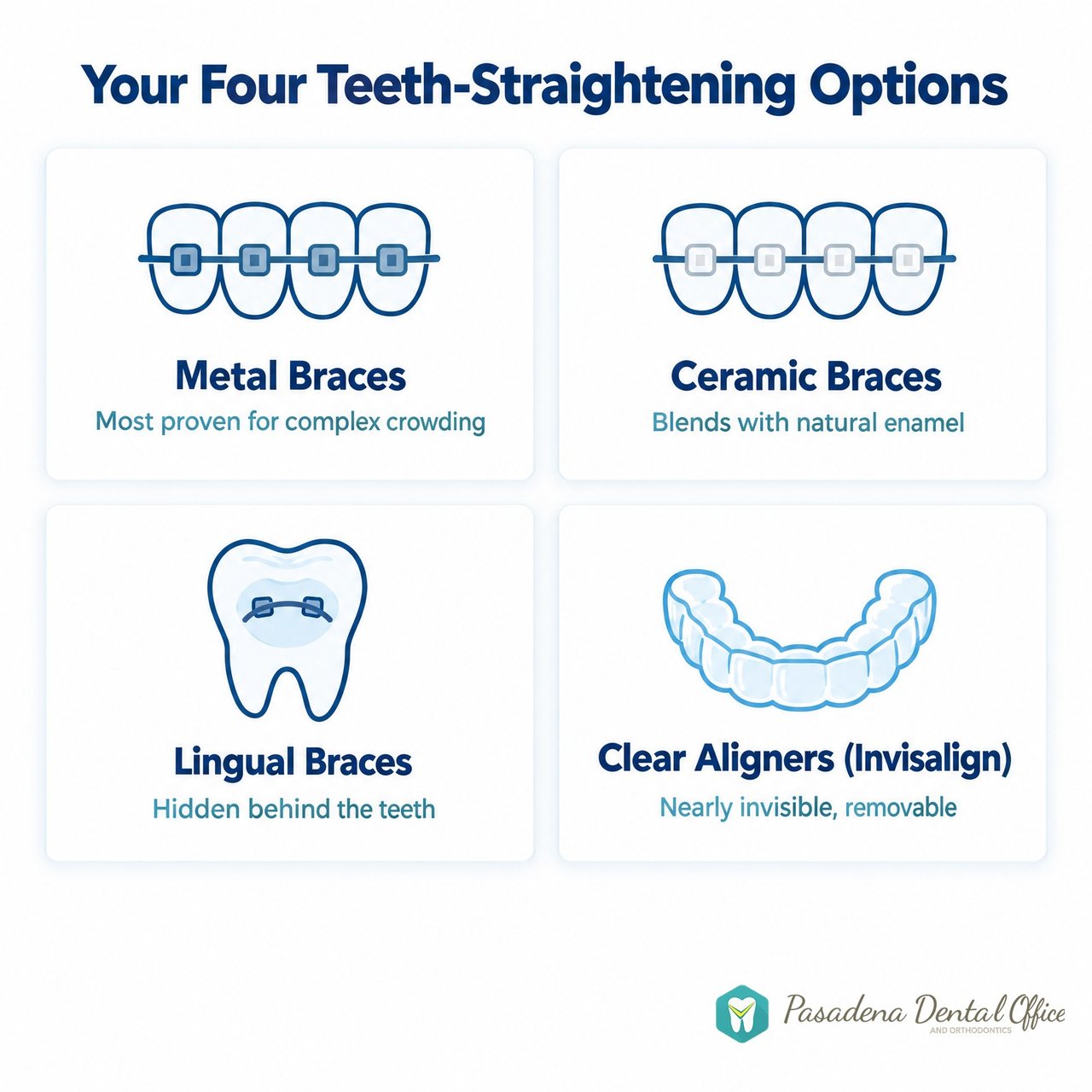
Pasadena Dental Office and Orthodontics offers four distinct teeth-straightening options: metal braces, ceramic braces, lingual braces and Invisalign clear aligners. Each option moves teeth using the same principle of steady pressure, but each looks, feels and fits into daily life differently. Dr. Heifets reviews a patient's bite, crowding pattern and lifestyle before recommending which option best matches their goals.
Metal Braces
Metal braces use brackets bonded to each tooth, connected by a thin archwire the dentist tightens at scheduled visits. This remains the most proven option for complex crowding, since it offers the most direct control over tooth movement. Traditional metal braces also cost less than other options, and self-ligating brackets are available for fewer friction points during adjustments. Kids and teens with developing jaws are frequently the best candidates, since their teeth respond quickly to steady pressure.
Ceramic Braces
Ceramic braces work like metal braces, with tooth-colored brackets that blend against natural enamel instead of standing out. The archwire still applies the same controlled pressure, so treatment time closely matches traditional metal braces. Patients who want real correction for complex crowding but worry about the visible look of metal often choose this option instead. Ceramic brackets are slightly more fragile than metal ones, so the dentist reviews care instructions at each visit.
Lingual Braces
Lingual braces attach brackets and an archwire to the back of each tooth, facing the tongue instead of outward. From the front, a lingual brace is essentially invisible, since nothing sits on the visible surface of any tooth. This option suits patients with significant crowding who still want a fully hidden appliance rather than a removable aligner. Lingual braces need more adjustment time for speech comfort than front-mounted braces, a trade-off the dentist reviews at the consultation.
Clear Aligners (Invisalign)
Clear aligners, including Invisalign, are a series of custom, removable plastic trays that gradually shift teeth into a planned final position. Because the trays are nearly invisible and removable for eating, brushing and flossing, this option appeals to patients who want a straighter smile without visible brackets. Invisalign suits mild to moderate crowding, spacing and bite issues best, and Dr. Heifets confirms candidacy with a full exam first.
Invisalign vs. Traditional, Ceramic and Lingual Braces: How to Choose
Choosing between Invisalign and traditional, ceramic or lingual braces comes down to visibility, case complexity and daily routine. Invisalign aligners are nearly invisible and removable, while metal and ceramic braces stay fixed to the teeth for the full treatment, visible to anyone looking closely. Lingual braces split the difference: fixed like metal braces, but mounted out of sight behind the teeth. Traditional metal braces still handle the most complex crowding and bite cases most reliably, since the dentist controls every adjustment directly rather than relying on a patient's own aligner discipline. The table below lines up all four options side by side.
| Option | Visibility | Removable | Best Suited For |
|---|---|---|---|
| Metal Braces | Visible metal brackets and wire | No | Complex crowding, significant bite correction |
| Ceramic Braces | Tooth-colored brackets, less visible | No | Complex crowding, discretion preferred |
| Lingual Braces | Nearly invisible from the front | No | Significant crowding, full discretion needed |
| Clear Aligners (Invisalign) | Nearly invisible | Yes | Mild to moderate crowding, spacing or bite issues |
Is Teeth Straightening Right for You? Adults, Teens and Every Smile In Between
Teeth straightening fits patients across every age group, from a teen with a first round of crowding to an adult revisiting a smile they have lived with for years. The practice evaluates candidacy by bite pattern and oral health, not by age alone.
A few common signs suggest a consultation is worth scheduling:
- Teeth that visibly overlap or sit crowded together
- Noticeable gaps between two or more teeth
- A bite where the upper or lower teeth protrude past the other
- Difficulty cleaning certain teeth because of how they are angled
Braces and Clear Aligners for Adults
Braces and clear aligners for adults address crowding, gaps and bite issues that were never corrected earlier in life. One in three orthodontic patients today is an adult, an all-time high for the profession.[1] Adult jaws have finished growing, so treatment relies more on steady aligner or bracket pressure than on guiding a developing bite. Many adults choose Invisalign specifically because the removable trays fit around a work schedule and social commitments more easily than fixed braces.
Braces for Kids and Teens
Braces for kids and teens typically begin while the jaw is still developing, often between ages 8 and 14. A developing jaw responds faster to the pressure from metal or ceramic braces than a fully grown adult jaw does. Dr. Heifets evaluates a child's bite and crowding pattern early, since starting treatment at the right age can shorten overall treatment time. Parents often ask about retainers at this stage too, since a retention plan follows every active treatment phase.
How Treatment Unfolds: From First Visit to Your Final Smile
Teeth-straightening treatment unfolds across five stages, from the first exam through the retention plan that protects the final result. Every patient starts at the same consultation step regardless of which option they eventually choose.
| Stage | What Happens | Typical Timing |
|---|---|---|
| Free Consultation and Exam | Dr. Heifets reviews digital images and discusses goals | First visit |
| Your Custom Treatment Plan | Option is chosen and a personalized plan is built | Within one to two weeks of the exam |
| Getting Your Braces or Aligners | Brackets are bonded, or the first aligner tray is fitted | One appointment |
| Progress Check-Ins | Wires are adjusted, or new aligner trays are issued | Every four to eight weeks |
| Your Reveal and Retention Plan | Appliance comes off and a retainer protects the result | End of active treatment |
Free Consultation and Exam
A free consultation and exam starts with digital imaging and a conversation about the patient's goals. Dr. Heifets reviews the images to confirm which of the four straightening options genuinely fits the patient's bite.
A first consultation at Pasadena Dental Office and Orthodontics typically includes the following:
- A full oral health check, including gum tissue around any crowded teeth
- CBCT 3D imaging to map the jaw and roots in detail
- A discussion of which treatment option best fits the patient's needs
- A review of insurance and financing options available at the practice
Your Custom Treatment Plan
A custom treatment plan maps out every adjustment or aligner tray a patient will need, start to finish. Dr. Heifets builds it directly from the CBCT imaging taken at the first visit, reflecting the patient's actual jaw structure rather than a general estimate.
Getting Your Braces or Aligners
Getting braces or aligners is the appointment where active treatment physically begins. For braces, the dentist bonds brackets to each tooth and threads the archwire through them. For clear aligners, the patient receives a first tray with wear instructions.
Progress Check-Ins
Progress check-ins happen every four to eight weeks, depending on the option chosen. Braces patients get their archwire tightened or swapped at each visit, while aligner patients pick up a new set of trays and get checked for fit.
Your Reveal and Retention Plan
A reveal and retention plan follows the day braces come off or the last aligner tray finishes. Teeth naturally drift back toward their original position without support, so every patient leaves with a retainer and wear instructions.
How Long Does Teeth Straightening Take?
Teeth straightening typically takes one to three years with traditional braces, often starting between ages 8 and 14, and a shorter span with clear aligners. Each clear aligner is typically worn about one week before moving to the next tray, with a recommended wear time of at least 22 hours a day, and full treatment often runs six to 18 months.[2] Treatment length depends mainly on how much crowding or bite correction a patient needs, not on which option they choose alone. A patient's own consistency matters too, since aligners worn fewer hours than recommended can extend the timeline past the original estimate. Dr. Heifets gives every patient a realistic timeline at the consultation, based on their specific bite and crowding pattern.
Treatment Cost, Insurance and Financing for Teeth Straightening in Pasadena
Treatment cost, insurance coverage and financing for teeth straightening in Pasadena depend on which option a patient chooses and how complex their case is. Metal braces, ceramic braces, lingual braces and clear aligners each carry a different price range, and insurance or financing can offset a meaningful share of that cost. The table below summarizes the two main ways patients cover that cost, and the three sections after it break down each one in detail.
| Payment Option | Examples | How It Helps |
|---|---|---|
| Dental Insurance | Delta Dental, MetLife, Aetna, Cigna and most other major PPO plans | Offsets a share of cost under the plan's orthodontic benefit |
| Third-Party Financing | CareCredit, Cherry, LendingClub, Sunbit, Premier Financing | Spreads remaining cost across monthly payment plans |
What Affects Your Treatment Cost
Treatment cost is shaped mainly by the option chosen, how complex the crowding or bite issue is and how long active treatment runs. Lingual braces and clear aligners generally cost more than traditional metal braces, since both require more customized components. A longer timeline, driven by more severe crowding, adds adjustment visits and typically raises total cost. Dr. Heifets provides a specific estimate only after a full exam confirms the treatment plan.
Insurance Coverage for Orthodontic Treatment
Pasadena Dental Office and Orthodontics accepts most major PPO insurance plans. Orthodontic coverage varies significantly from plan to plan, and some plans apply a separate lifetime orthodontic maximum instead of an annual one. Accepted PPO plans include:
- Delta Dental, MetLife and Guardian
- Aetna, Cigna and Anthem Blue Cross
- Blue Shield, United Healthcare and Humana
- Most other major PPO plans, confirmed at the consultation
The practice reviews each patient's specific plan details before treatment starts, so the estimate reflects real coverage rather than a general assumption.
Financing Options at Pasadena Dental Office and Orthodontics
Pasadena Dental Office and Orthodontics works with five financing partners: CareCredit, Cherry, LendingClub, Sunbit and Premier Financing. Each partner offers its own monthly payment plans, so a patient without full insurance coverage can still spread treatment cost over time. Financing is provided directly through these partners, not through the practice itself.
Digital Imaging and Precision Tools Behind Your Treatment Plan
Digital imaging and precision tools behind every treatment plan start with 3D CBCT imaging and digital X-rays taken at the first visit. This imaging technology captures a detailed, three-dimensional view of the jaw, roots and surrounding bone that a flat two-dimensional X-ray cannot show. Dr. Heifets uses these images to map exactly how much movement each tooth needs, rather than estimating from a visual exam alone. Digital X-rays also expose patients to less radiation than older film X-rays, while still giving clear images the dentist can review the same day. This equipment is one part of the broader dentistry services the practice provides under one roof.
Advanced imaging at the practice supports treatment planning in several concrete ways:
- Mapping root position and jaw structure in three dimensions before any bracket or aligner is designed
- Catching bite issues that a visual exam alone could miss
- Giving Dr. Heifets precise measurements for a customized treatment plan
- Letting the team track progress at each check-in against the original images
Dr. Heifets and the Care Behind Your Straightening Treatment in Pasadena
Dr. Heifets and the team behind every straightening treatment in Pasadena combine same-day availability with hands-on provider expertise. Dr. Solomon Heifets, DDS, trained at Moldova University School of Dental Medicine and serves as the practice's primary dentist, reviewing every teeth-straightening case personally before treatment starts. The practice also offers same-day and emergency appointments, so a loose bracket or lost aligner does not have to wait days for an open slot. Pasadena Dental Office and Orthodontics keeps every stage of treatment, from the first CBCT scan to the final retainer, under one roof instead of referring patients out to a separate specialist. Patients can read more about Dr. Heifets and his background on his dedicated provider page.
Discomfort, Compliance and the Honest Trade-Offs Between Braces and Aligners
Discomfort, compliance and honest trade-offs between braces and aligners vary by option, and every patient deserves a clear picture before choosing. Braces apply constant pressure and require diet caution, while clear aligners demand more personal discipline to wear them as directed. Neither option is effort-free, and the sections below lay out what each one asks of a patient.
| Factor | Braces | Clear Aligners |
|---|---|---|
| Adjustment Discomfort | Soreness for a few days after each tightening | Pressure for a day or two with each new tray |
| Daily Compliance Needed | Low, since the appliance is fixed in place | High, requires 22+ hours of wear a day |
| Diet Restrictions | Sticky and hard foods should be avoided | None, trays are removed before eating |
| Speech Impact | Minimal adjustment period | Mild, temporary lisp possible with new trays |
Discomfort and the Adjustment Period
Discomfort during the adjustment period is common with both braces and clear aligners, though it shows up differently. Braces patients typically feel soreness for a few days after each wire tightening, as teeth respond to renewed pressure. Clear aligner patients often feel tenderness for a day or two after switching to each new tray. Over-the-counter pain relief and soft foods usually manage this discomfort until it passes.
Why an In-Person Exam Matters More Than Mail-Order Convenience
An in-person exam matters more than mail-order convenience because a dentist can catch problems a remote scan cannot. Seventy-seven percent of surveyed orthodontists reported seeing patients return for retreatment after mail-order aligner therapy that skipped an in-person exam, and 61 percent see this at least quarterly.[3] Dr. Heifets physically examines gum health, bite alignment and root position before recommending any aligner or bracket system. This in-person step is exactly what a mail-order aligner company cannot replicate from a photo or a digital scan alone.
Refinement Rounds and Speech Changes With Clear Aligners
Refinement rounds and mild speech changes are a real, limited trade-off some clear aligner patients experience. A refinement round is an added set of trays for teeth that need extra adjustment beyond the original plan, and it happens often enough to expect. Some patients also notice a temporary lisp for the first day or two after starting a new aligner, which fades as the tongue adjusts.
Who Teeth Straightening May Not Be Right For
Teeth straightening may need to wait for patients with active, untreated gum disease or certain complex bite conditions. Moving teeth through inflamed gum tissue can worsen both problems at once. Dr. Heifets addresses any active gum disease first, then revisits straightening once the mouth can support tooth movement safely.
Reviews From Our Pasadena Patients
Reviews from Pasadena patients reflect the day-to-day experience of visiting Pasadena Dental Office and Orthodontics. Jon, a patient on Google, shared: “The place very friendly, love the people from Carlos to Susan, Dr. Solomon, everything was up to par.” Reviews like this one reflect the same team patients meet at every visit, whether they come in for a cleaning or a full course of orthodontic treatment.
Getting Started: Your Free Consultation in Pasadena
Getting started with a free consultation in Pasadena begins with a single call or online request to the practice. This complimentary consultation gives Dr. Heifets time to review each patient's bite, crowding pattern and goals, then recommend which of the four straightening options fits best. Pasadena Dental Office and Orthodontics welcomes patients throughout the greater Pasadena CA area, including:
- Pasadena
- South Pasadena
- Altadena
- the greater San Gabriel Valley
The practice is located at 181 N Hill Avenue, Pasadena, CA 91106, open Monday through Friday from 9AM to 6PM. Contact us at (626) 219-7180 to schedule a consultation and start a treatment plan built around your own smile.
Braces or Clear Aligners? Questions Pasadena Patients Ask Before Deciding
How Much Does Invisalign Cost in California?
Invisalign cost in California depends on case complexity, treatment length and whether insurance applies toward orthodontic care. Dr. Heifets provides a specific estimate only after reviewing a patient's CBCT imaging and bite during their consultation.
Do Clear Aligners Really Work?
Clear aligners genuinely work for mild to moderate crowding, spacing and bite issues when worn as directed. Each tray applies the same steady pressure principle that braces use, just through a removable, custom-fit plastic tray instead of fixed brackets.
How Much Does It Cost to Get Your Teeth Straightened?
The cost to get teeth straightened depends on which of the four options a patient chooses and how complex their case is. Insurance and the practice's five financing partners can both reduce the amount a patient pays out of pocket.
How Long Does It Take Braces to Fix a Misaligned Jaw?
Braces typically take one to three years to fix a misaligned jaw, depending on how severe the bite issue is. Starting treatment between ages 8 and 14, while the jaw is still developing, often shortens the overall timeline.
Which Teeth-Straightening Option Is Most Discreet?
Lingual braces and clear aligners are the two most discreet options, since neither shows visible brackets on the front of the teeth. Clear aligners add the option to remove the tray entirely for a meal, a photo or a meeting.
Can I Get Clear Aligners or Braces Near Me in Pasadena?
Clear aligners and braces are both available at Pasadena Dental Office and Orthodontics, located at 181 N Hill Avenue in Pasadena. The practice also serves patients from South Pasadena, Altadena and the surrounding San Gabriel Valley.
Pasadena Dental Office and Orthodontics gives patients a real choice among four straightening options, backed by digital imaging and a dentist who reviews every case personally. Dr. Heifets and the team guide each patient from that first consultation through the final retainer, with insurance and financing support built in. A straighter smile starts with one call to (626) 219-7180 or a visit to the practice's Pasadena office.
Insurance coverage for orthodontic treatment varies by plan and can change at any time. Patients should confirm their own coverage for teeth straightening directly with their insurance provider before starting treatment.