
What Is a Dental Filling, and When Do You Need One?
A dental filling is a restorative material placed into a cleaned-out cavity to stop decay and restore the tooth. The dentist removes the decayed portion first. This step also seals out bacteria and rebuilds the tooth's shape. A filling belongs to a broader category called dental restorations. Crowns belong to this same category too, sized to the damage present. Several signs tell a patient a filling is likely needed before any pain sets in.
A standalone symptom does not confirm a cavity on its own, so Dr. Heifets checks each sign against a digital X-ray or 3D CBCT scan. A filling differs from cosmetic dental bonding, which repairs a chip or gap without underlying decay. Routine fluoride treatments, dental sealants, and cleanings help prevent new cavities between visits. The practice's tooth decay page covers prevention in full.
- Sharp sensitivity to sweets, hot drinks, or cold air
- A visible dark spot or discoloration on the tooth surface
- A rough edge or pit the tongue keeps finding
- A small hole confirmed on a dental X-ray before any pain starts
- Food that consistently catches in one spot between the same two teeth
Key takeaway: early sensitivity and a visible dark spot most often bring patients in for a filling. Medically reviewed by Dr. Solomon Heifets, DDS.
Composite vs. Amalgam: Choosing the Right Filling Material
Composite vs. amalgam comes down to two different filling materials, each with its own makeup and use. Composite resin is a tooth-colored plastic and glass blend that bonds directly to enamel. Amalgam is a silver-colored metal alloy that has filled cavities for more than a century. Pasadena Dental Office and Orthodontics places tooth-colored composite fillings. Amalgam appears below only for comparison. Patients in Pasadena regularly ask about it, though it is not an in-office option here.
Tooth-Colored Composite vs. Silver Amalgam: A Side-by-Side Look
Tooth-colored composite and silver amalgam differ in appearance, placement, and chair time, not just color. Composite resin blends into the surrounding enamel, so dentists use it on front and back teeth alike. Amalgam's metallic surface stands out more than composite's tooth-colored finish. Where still used, most practices reserve it for back molars patients rarely show. Composite also requires a dry field during placement. The dentist cures it in layers under a light, adding a few extra minutes compared with amalgam.
| Factor | Tooth-Colored Composite | Silver Amalgam |
|---|---|---|
| Appearance | Matches natural tooth color, mercury-free | Silver-gray metal alloy, visible when the mouth opens |
| Typical location | Front and back teeth | Back molars only, where used |
| Chair time | Slightly longer, placed and light-cured in layers | Shorter, condensed and left to set |
| Bonding to tooth | Bonds directly to enamel | Mechanically locked, not bonded |
| Offered at this practice | Yes, the practice's standard filling material | Not currently listed as an offered service |
Is Amalgam Safe? What the FDA and ADA Actually Say
Amalgam is safe for most adults, according to the FDA. Seven higher-risk groups are advised to avoid it when possible. Amalgam is roughly fifty percent mercury by weight. It releases a very small amount of mercury vapor each day. That amount runs between two and four tenths of a microgram per filled surface.[1] Composite offers a mercury-free alternative that works well for most patients. As reported by the FDA, these seven groups should avoid new amalgam fillings when possible:
- Pregnant women and their fetuses
- Women planning pregnancy
- Nursing women and their infants
- Children, especially under age six
- People with pre-existing neurological disease
- People with impaired kidney function
- People with a known mercury allergy
The same FDA communication adds a second, equally important point. An existing, intact amalgam filling should not be removed unless medically necessary. Removing it releases more mercury vapor than simply leaving it in place. Allergic reactions to amalgam affect fewer than one percent of patients. Patients curious about material choice can raise the question directly with Dr. Heifets at their exam.
The Filling Procedure at Pasadena Dental Office and Orthodontics: What to Expect
The filling procedure at Pasadena Dental Office and Orthodontics follows a consistent sequence from numbing to polish. Dr. Heifets confirms the cavity's size first using a digital X-ray or 3D CBCT scan. He then numbs the area with local anesthesia. Patients who request it can add IV moderate sedation before the first step. The rest of the visit moves through five short stages.
Remove the decayed portion of the tooth
Clean and dry the prepared cavity
Place the composite resin and shape it to the tooth
Light-cure the composite in thin layers until it hardens
Polish the surface and check the bite for a comfortable fit
Dr. Heifets performs every step himself, from the first numbing injection to the final bite check. Most single-tooth fillings finish within one appointment and require no second visit.
Filling Durability: Composite vs. Amalgam Lifespan and What Actually Shortens It
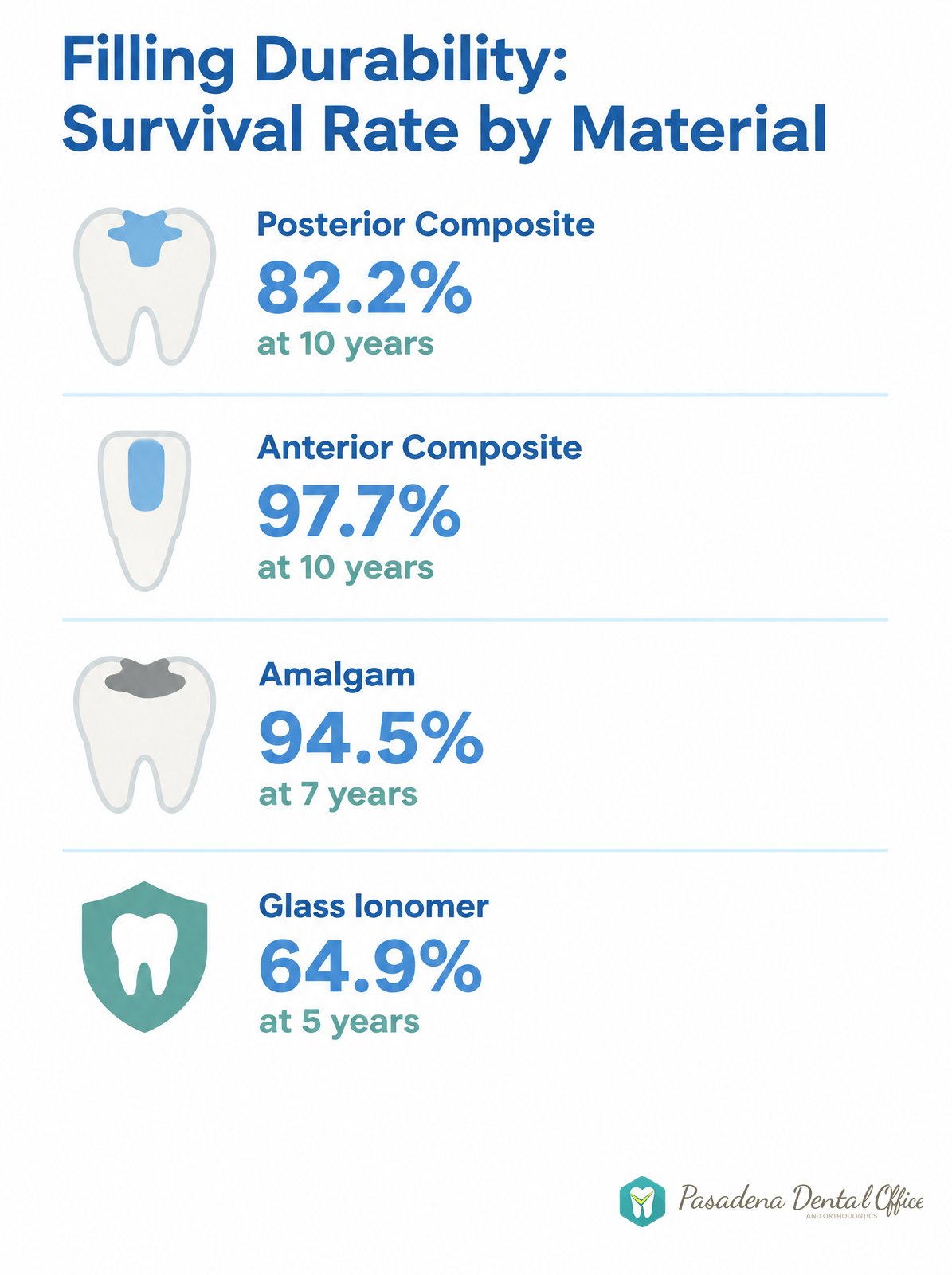
Filling durability depends more on a patient's habits than on which material was chosen. As stated by the American Dental Association's own survival-rate table, both materials hold up well over many years.[2] The table below breaks down the exact survival rate for each material and timeframe. The ADA's own conclusion is direct. Evidence of any real longevity difference between materials stays limited. Patient behavior remains the biggest factor in how long a filling lasts. Several specific habits shorten a filling's life regardless of material.
| Restoration Type | Survival Rate | Timeframe |
|---|---|---|
| Posterior composite (back teeth) | 82.2% | 10 years |
| Anterior composite (front teeth) | 97.7% | 10 years |
| Amalgam | 94.5% | 7 years |
| Glass ionomer | 64.9% | 5 years |
Grinding or clenching at night wears down a filling's edge faster than normal chewing. Chewing ice or hard candy can chip or crack a filling outright. Poor brushing at the filling's margin lets new decay start underneath it. Large, multi-surface fillings carry more stress than a small, single-surface one. None of these factors depend on whether the filling is composite or amalgam.
Fillings vs. Root Canal, Inlay, Onlay & Crown: When You Need More Than a Filling
Fillings stop working as a solution once decay spreads past what a simple restoration can repair. A filling is enough when decay is caught early and the tooth's healthy structure still outweighs the damaged part. Once decay reaches the tooth's nerve, a bigger restoration becomes the better option. The same is true once a large portion of the tooth has broken down. Left untreated long enough, advanced decay risks tooth loss, not just a bigger filling. The table below lines up each escalation point against what it actually involves.
| Restoration | When It's Needed | What It Involves |
|---|---|---|
| Filling | Decay caught early, tooth structure mostly intact | Composite placed directly into the cleaned cavity |
| Inlay or onlay | Decay too large for a filling, cusp still intact | Lab-made restoration bonded into or over the tooth |
| Crown | Most of the tooth's visible structure is compromised | A cap covers and protects the entire tooth |
| Root canal therapy | Decay has reached the nerve, causing infection or pain | Infected tissue removed, canal sealed, often capped with a crown |
Patients who need more than a filling can read more on three dedicated pages. These cover root canal therapy, dental crowns, and the practice's full restorative dentistry services.
Caring for Your Filling: Aftercare and Long-Term Habits
Caring for a new filling mostly means waiting out normal numbness and watching for sensitivity that does not fade. Patients with a composite filling on a front tooth should avoid coffee, tea, or red wine. Waiting one day prevents surface staining while the composite fully sets. Brushing resumes normally once the numbness wears off, usually within a few hours. Mild sensitivity to hot or cold is common for a few days and typically resolves on its own.
A short list of aftercare steps keeps a new filling comfortable and protected.
- Avoid chewing on the treated side until numbness fully wears off
- Skip staining foods and drinks for 24 hours after a front-tooth composite filling
- Brush and floss normally once feeling returns to the area
- Call the office if sensitivity lasts longer than two weeks or worsens
- Keep routine cleanings and exams on schedule to protect the filling's margin
Routine cleanings and exams catch early wear at a filling's edge before it turns into new decay underneath it.
Filling Costs, Insurance & Financing in Pasadena
Filling costs in Pasadena rank among the more affordable restorative procedures this practice offers. A single tooth-colored filling typically runs $150 to $300, in line with the $226 national average cost of a composite filling.[3] The exact price depends on the tooth treated and how much structure the decay affected. Most PPO dental insurance plans include some filling coverage. Pasadena Dental Office and Orthodontics accepts most major PPO plans. These include Delta Dental, MetLife, Cigna, and Anthem Blue Cross, among others. The office does not accept Medi-Cal or HMO plans. Patients without full coverage have financing options to spread out the cost.
- CareCredit
- Cherry
- LendingClub
- Sunbit
Filling Cost Drivers: Material, Tooth Location & Extent of Decay
Filling cost drivers come down to three practical factors a dentist weighs during the exam. These are the material used, the tooth's location, and how many surfaces the decay affects. The table below explains why each factor changes the final price.
| Cost Driver | Why It Affects Price |
|---|---|
| Material (composite) | Requires layered placement and light-curing time |
| Tooth location | Back teeth take longer to access and shape |
| Number of surfaces | A multi-surface filling needs more material and time |
| Insurance coverage | Confirmed PPO benefits can lower the out-of-pocket total |
Cavities & Fillings FAQs
What is the average cost of a filling at a dentist?
A tooth-colored filling at this practice typically costs $150 to $300. The exact price depends on the tooth treated and how much decay needs removing.
How much does dental filling cost?
Dental filling cost at Pasadena Dental Office and Orthodontics runs $150 to $300 per tooth. Most PPO insurance plans cover some portion of that amount.
Is 7 fillings a lot at once?
Treating several teeth in one visit is common when more than one tooth has decay. IV moderate sedation is available for patients who prefer to complete extensive work in fewer appointments.
How much is 2 cavity fillings?
Two fillings cost roughly double a single filling's $150 to $300 range. The exact total depends on which teeth are involved. Dr. Heifets provides a firm estimate at the exam.
Does Medi-Cal cover cavity filling?
No. Pasadena Dental Office and Orthodontics accepts most major PPO dental insurance plans but does not accept Medi-Cal or HMO plans.
Can a stage 1 cavity be reversed?
A very early cavity limited to the outer enamel can sometimes reverse. Fluoride and improved oral hygiene can manage it before it needs a filling. The practice's tooth decay page covers these early stages in full.
Where can I get a filling near me in Pasadena?
Pasadena Dental Office and Orthodontics places fillings at 181 North Hill Avenue. The office serves Pasadena, South Pasadena, San Marino, Altadena, and Alhambra.
How long does a filling last?
Composite fillings commonly last many years with good oral hygiene. Exact survival rates by material appear in the Filling Durability section above.
Cavities & Fillings Care Serving South Pasadena, San Marino, Altadena & Alhambra
Cavities and fillings care from Pasadena Dental Office and Orthodontics reaches patients well beyond Pasadena proper. The 181 North Hill Avenue office sits close to South Pasadena, San Marino, Altadena, and Alhambra. Same-day filling appointments stay practical across the whole San Gabriel Valley. Dr. Heifets and the team also provide root canal therapy, porcelain crowns, dental bridges, and dentures under the same roof. The practice also offers dental implants, gum disease treatment, cosmetic dentistry, and orthodontic care such as Invisalign. Patients can call the office directly or request an appointment online.
A dental filling repairs decay before it threatens the rest of the tooth. Dr. Solomon Heifets, DDS, places tooth-colored composite fillings at Pasadena Dental Office and Orthodontics. Digital X-rays and 3D CBCT imaging confirm every diagnosis first. Most PPO insurance plans and several financing partners make treatment manageable for patients across the San Gabriel Valley. Call 181 North Hill Avenue's office at (626) 219-7180 or book a filling appointment online today.
Dental insurance coverage varies by plan and can change without notice. Patients should confirm their own plan's coverage for fillings directly with their insurance provider before treatment.