What Are Dental Veneers and What Do They Cover?
Dental veneers are thin custom shells of porcelain or composite resin bonded to the front surface of a tooth. They cover chips, stains, small gaps, and uneven edges that change how a smile looks. They do not straighten a bite or repair major structural damage. Veneers are used to correct a wide range of cosmetic concerns. Porcelain and composite are the two main materials. Each shell is shaped to blend with your natural teeth in color, length, and outline. A conventional porcelain veneer needs a thin layer of enamel removed, and that removal is permanent. Cosmetic dentistry offers many ways to change a smile, from whitening to bonding to crowns. Veneers sit between a filling and a full crown in how much tooth they involve. Because the shell bonds to enamel, healthy enamel and healthy gums matter more than any other factor. Dentists sometimes call these shells laminates or porcelain shells, and all of those names describe the same idea. Veneers usually go on the teeth that show when you smile. The upper front teeth come up most often. Your dentist checks whether your teeth can support one during your consultation. You also learn what the treatment asks of you in the years afterward. Thickness varies with the material and the tooth. Every shell is designed to sit flush with the gum line. A well-made veneer should feel like part of the tooth, not like an add-on. That result depends on precise shaping, accurate impressions, and a bond that seals cleanly at the edges. Patients often ask whether veneers look fake, and the concern is fair. Careful shade matching and good lab work make that outcome less likely. The temporary phase also lets you review the shape before the final set is bonded.
What Can Veneers Fix on Chipped, Stained, Gapped or Uneven Teeth?
Veneers fix chipped, stained, gapped, and uneven teeth by covering the visible front surface with a custom shell. They improve appearance without changing how the tooth works. The shell hides the flaw and restores a smooth, balanced outline. Five concerns bring most patients to a veneer consultation, and each one responds differently. Your dentist matches the solution to the cause, not just to the appearance. Sometimes a veneer is the right answer, and sometimes a simpler treatment does the job with less tooth reduction.
Chipped, Worn or Cracked Teeth
Veneers cover chipped, worn, and cracked front teeth by replacing the lost edge with a smooth shell. A small chip sometimes needs only a light bonded repair, so your dentist compares the options first. Worn edges from years of grinding respond well once the grinding itself is managed. A crack that runs deep into the tooth may call for a crown instead. Either way, the goal is a tooth that looks whole and feels smooth against your tongue. Bring up any tooth that catches your lip or snags floss, because rough edges are worth a look. Small changes in a chipped tooth can also signal a crack that needs attention.
Stained or Discolored Teeth
Veneers conceal deep stains that whitening cannot lift. Intrinsic stains sit inside the tooth. Common causes include tetracycline exposure, a darkened root-filled tooth, and excess fluoride during childhood. Porcelain resists staining well, though it is not stain-proof, so daily hygiene still matters. The natural teeth beside it can still darken, which is another reason to plan whitening first. Whitening your natural teeth first gives the dentist a clear target when choosing the veneer shade. If only some teeth are stained, the dentist may treat those and whiten the rest to match. A single darkened tooth after a root canal is a common reason patients ask about one veneer.
Gaps Between Teeth
Veneers close small gaps between teeth by widening each shell slightly. A small space usually suits this approach, and the result looks like one continuous row of teeth. Larger spaces can look bulky once closed with porcelain, so orthodontic treatment may come first. Your dentist explains which path fits your spacing before any enamel is touched. Gaps also change how food and floss move between teeth, so ask how the new contact points will feel. Closing a gap can make cleaning easier for some patients and harder for others, depending on the fit.
Short, Uneven or Misshapen Teeth
Veneers even out short, uneven, and misshapen teeth by reshaping their length, width, and edge symmetry. Front teeth benefit most because they frame the smile. Worn or peg-shaped incisors can be lengthened to match their neighbors. The dentist plans the proportions so the finished set looks balanced across the whole smile. The goal is a pleasing shape that suits your face. That planning matters more than any single tooth. A row of teeth that follows the curve of your lower lip reads as natural. Uneven edges often come from years of wear, so ask whether a bite issue is behind them.
Slightly Crooked Teeth
Veneers mask slightly crooked teeth, but they do not move teeth. A mild twist or overlap can look straighter once the shell reshapes the visible surface. True misalignment, such as a crowded arch or a bite problem called malocclusion, needs orthodontic movement. The comparison section later on this page explains when clear aligners, veneers, or both make sense. Be plain with your dentist about how much change you expect, so the plan matches the goal.
Porcelain, Composite and Lumineers: Which Veneer Type Fits Your Teeth?
Porcelain, composite resin, and Lumineers are the veneer types most patients compare. The right fit depends on your teeth. Each material trades appearance against durability and enamel removal in a different way. Lumineers are a brand of thin porcelain veneer, and composite veneers use tooth-colored resin built up on the tooth. Material affects appearance, strength, repair options, and how much enamel comes off. Dental aesthetics matter, but function matters just as much. Dentists weigh your tooth color, your bite, your habits, and your goals before recommending one. A patient who grinds may need a different material than a patient who does not. The table below sets the three side by side.
| Veneer type | Where it is made | Enamel removal | Main strength | Main trade-off |
|---|---|---|---|---|
| Porcelain veneers | Dental lab, from impressions | Usually a thin layer | Lifelike translucency and stain resistance | Needs lab time and a temporary phase |
| Composite resin veneers | Shaped on the tooth at the chair | Often less than porcelain | Easy to repair | Stains and wears sooner over time |
| Lumineers and other thin porcelain | Dental lab, from impressions | Sometimes minimal, depending on the tooth | Thinner shell | Poor fit for dark, bulky, or widely spaced teeth |
Porcelain Veneers in Pasadena
Porcelain veneers in Pasadena are custom ceramic shells that a dental lab makes from impressions of your prepared teeth. Porcelain reflects light the way natural enamel does, which gives it a lifelike glow. Its glazed surface resists staining better than resin. Preparation usually removes a thin layer of enamel, so the treatment is a lasting commitment. Most patients who want a result that stays bright for years choose porcelain dental veneers for those reasons. The lab also matches the subtle color changes in a tooth. A darker neck near the gum blends into a lighter, more translucent edge. That layering is hard to imitate with a single shade of resin. Porcelain is also stiff, which helps it hold its shape under daily biting when it is well bonded. The trade-off is that a cracked porcelain shell often needs replacement, not repair.
Composite Resin Veneers
Composite resin veneers are built up directly on the tooth with tooth-colored material. The dentist shapes and hardens the resin during the visit, so no lab is involved. Resin often needs less enamel removal than porcelain. A chipped edge can be repaired without replacing the whole veneer. The trade-off is durability, because resin tends to stain and wear sooner than porcelain. Ask at your consultation which material suits your goals and your bite. Resin can also serve as a preview of what a bigger change might look like. That trial does not commit you to porcelain later. Your dentist can say whether resin is the smarter first step for a single small flaw.
Lumineers and Other Minimal-Prep Veneers
Lumineers are ultra-thin porcelain veneers, and the practice lists them among its cosmetic options. A thinner shell can sometimes need less enamel removal, but your dentist confirms whether that holds for your teeth. Thin veneers suit some smiles and not others. Dark teeth, large gaps, and bulky teeth often need a thicker shell. It hides the color and shapes the tooth well. A thin shell placed over a tooth that already sits forward can also make the tooth look too large. Your dentist weighs these limits honestly before recommending any brand. Ask how much enamel removal your specific teeth would need. Ask to see how the plan protects it.
What Benefits Can You Expect From Veneers?
Veneers deliver a lifelike, evenly shaped smile with less tooth reduction than a full crown. Results vary by person, so your consultation sets realistic expectations before you commit. The benefits below explain how veneers create that result.
The main benefits patients notice include:
- Creates a natural look, because porcelain reflects light much like enamel does.
- Restores the outline of chipped, worn, or short front teeth.
- Helps mask deep stains that whitening cannot lift.
- Provides coverage for only the front surface, so the back and sides of the tooth stay untouched.
- Encourages steady confidence in photos and conversation, an effect that differs from patient to patient.
Your goals matter more than any list. A veneer should serve the way you want to look and the way you live. Some patients want one even tooth, and others want a fuller set. Tell the dentist which photos or moments bother you most, and the plan will start there. Confidence is personal, so this page describes it instead of measuring it. Ask to see the shade and shape options before the lab begins. A clear conversation about goals at the start prevents disappointment later. Patients who feel heard tend to feel better about the final result. Photos of your teeth today give the dentist a useful starting point for comparison.
Who Is a Good Candidate for Veneers in Pasadena?
A good candidate for veneers has healthy gums, enough enamel, no untreated decay, and realistic expectations. Those four factors decide whether a bonded shell will last. The dentist confirms each one with an exam and digital X-rays. Candidates for porcelain veneers share these four traits. Good oral hygiene and sound oral health give the bond its best chance. Anyone with active gum disease or heavy grinding usually needs other care first. That is a normal part of a careful plan, not a rejection. Age matters less than tooth and gum health. Adults of many ages receive veneers, provided the teeth are fully developed and the mouth is healthy. Younger patients usually need extra caution, because their teeth and gums are still changing. Smoking, uncontrolled gum disease, and untreated decay all reduce the odds of a lasting result. Realistic expectations complete the picture. Veneers can transform an edge or a shade, but they cannot make your teeth look like anyone else's. The two subsections below separate the signs that point toward veneers from the situations that point elsewhere.
Signs That Veneers May Suit You
Signs that veneers may suit you show up during the exam and in how you describe your goals. Consider the following signs:
- Enough healthy enamel on the teeth to be treated.
- Healthy gums with no active infection.
- A visible cosmetic concern, such as a chip, stain, or gap.
- A stable bite that does not put heavy force on the front teeth.
- A willingness to keep up daily hygiene and regular checkups.
No single sign decides the question. The dentist weighs them together during the exam. If one or two are missing, there is often a fix. Treating gum inflammation first or fitting a night guard are common examples. A short delay for preparation usually improves the final result. Gum health deserves special attention, because inflamed gums bleed during bonding and can disturb the seal at the edge.
Situations That Call for a Different Treatment
Situations that call for a different treatment are common, and a good dentist names them plainly. Some conditions must be handled before veneers, and some replace veneers altogether:
- Active decay or advanced gum disease, which needs treatment first.
- Heavy grinding without a night guard, which can break thin shells.
- Very little enamel, which weakens the bond.
- Large structural damage, which usually needs a crown.
- Teeth that need to move, which calls for aligners or braces.
A tooth that has had a root canal can be more fragile. Its color may also look darker through the shell. Your dentist plans for that case with extra care. Being told to wait or to choose another treatment is useful information. It protects your teeth and your investment. A conservative first step, such as whitening or bonding, can sometimes solve the problem with less tooth reduction. You can always revisit veneers later.
What Can Go Wrong With Veneers, and How Often?
Veneers can chip, come loose, or discolor at the edges, though most survive for many years. Failures are uncommon but real, and knowing them helps you decide with clear eyes. Each risk has a practical safeguard. Careful preparation, a fit check with temporary veneers, a night guard when indicated, and regular checkups all help. Rarer issues include sensitivity, gum irritation at the edge, and a shade that looks slightly off in certain light. Most are managed with an adjustment or by replacing the single affected veneer. The three risks below cover most of what patients ask about. None of them is a reason to avoid veneers. Each one is a reason to plan carefully and to choose a dentist who explains the trade-offs.
Chipping, Debonding and Other Failures
Chipping and debonding are the most common ways a veneer stops doing its job. According to the American Dental Association, porcelain and glass-ceramic laminate veneers show 89 percent survival. That figure reflects an average of 9 years. The same review lists chipping at 4 percent and debonding at 2 percent among the failure modes.[1] Most veneers therefore stay in place, and a chipped or loose one is usually repaired or replaced. Report any rough edge or looseness early, because small problems are easier to fix. Regular checkups let the dentist spot early wear before you feel it. Biting hard items and taking a blow to the mouth are the usual causes of chips. Debonding means the bond between veneer and tooth has failed, so the shell lifts or falls off. Moisture during placement, heavy bite forces, or trauma can each contribute. If the veneer stays intact, the dentist decides whether it can be bonded again.
Why Enamel Removal Is Permanent
Enamel removal is permanent because enamel does not grow back. A conventional porcelain veneer needs a thin layer removed. The tooth then needs some form of coverage from that point on. As reported by Gurel and colleagues in a 2013 study, veneers prepared entirely within enamel showed 99 percent survival. The study appeared in the International Journal of Periodontics and Restorative Dentistry. Veneers bonded to exposed dentin were about ten times more likely to fail.[2] That finding explains why dentists plan preparation depth instead of guessing it. Enamel is the surface the bond grips best, so the plan protects as much of it as possible.
Why Grinding Puts Veneers at Risk
Grinding puts veneers at risk because biting force lands on thin edges. Sleep grinding is common. As per the American Academy of Sleep Medicine, about 8 percent of young to middle-aged adults do it.[3] Many people never notice it. If your dentist sees flat, worn edges, a night guard can protect your teeth from wear. A night guard does not stop the grinding. It gives your teeth a softer surface to meet. Tell the dentist if you wake with a sore jaw or morning headaches. Clenching stresses veneers as much as grinding does. Flat edges, cracked fillings, and tired jaw muscles are common clues. A quick check at your consultation costs nothing and can save a veneer.
How Does the Veneer Process Work, Step by Step?
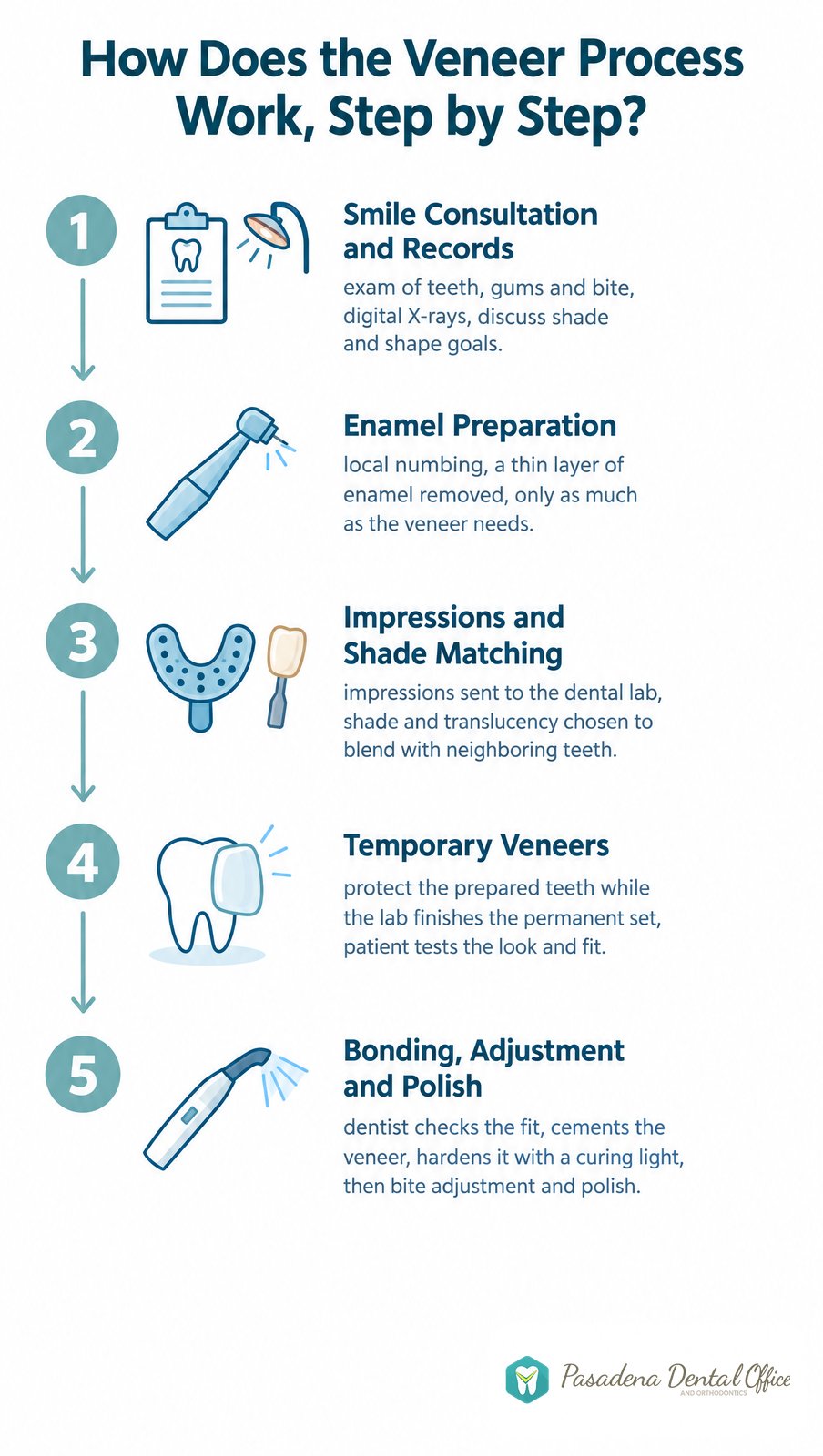
A personalized veneer plan moves through five stages: consultation, enamel preparation, impressions, temporary veneers, and bonding. Your dentist evaluates first, prepares next, takes impressions, places temporaries, and finally bonds the permanent shells. Local numbing keeps preparation comfortable. IV moderate sedation is also available for patients who feel anxious about dental work. Most patients ask how many visits the process takes. The answer depends on the number of teeth, the material, and the lab. The dentist gives you a plan after the exam. Ask the team how the visits fit your schedule. The plan should also spell out what you do at home between visits, so nothing catches you off guard.
Step 1: Smile Consultation and Records
The smile consultation and records visit starts with your goals. It works as your initial consultation. The dentist examines your teeth, gums, and bite, and takes digital X-rays. You discuss the shade and shape you want, and the dentist explains which teeth are suitable. Questions about cost, care, and timing belong in this visit as well. Nothing is decided at this stage, and you can leave to think it over. Bring photos of smiles you like, and mention anything about your teeth that bothers you. The dentist also reviews your medical and dental history so nothing surprises either of you later. You leave knowing the next step for your smile, even if that step is not veneers.
Step 2: Enamel Preparation
Enamel preparation begins with numbing, so you feel pressure instead of pain. The dentist then removes a thin layer of enamel, only as much as the veneer needs. Staying within enamel matters because bonding holds best there. Careful shaping also leaves room so the finished veneer does not look bulky. Most patients describe vibration and noise more than discomfort. The dentist works slowly near the gum line, where the tissue is most sensitive. Raise a hand if you need a break at any point. Numbing wears off within hours after the visit, so plan a soft meal for afterward.
Step 3: Impressions and Shade Matching
Impressions and shade matching capture the shape of your prepared teeth. The impressions go to a dental lab, where technicians craft each customized veneer. The dentist chooses a shade and translucency that blend with your neighboring teeth. Natural teeth are rarely one flat color, so the match looks at brightness, warmth, and see-through edges. Share photos of smiles you like, since they help the dentist judge length and brightness.
Step 4: Temporary Veneers
Temporary veneers protect the prepared teeth while the lab finishes your permanent set. They also let you test the look and the fit. Tell the dentist about anything that feels too long, too thick, or awkward when you speak. Changes are easier to make at this stage than after bonding. Wear the temporaries through real meals and conversations, and note anything that bothers you. Temporaries are less sturdy than the final shells, so treat them with care. Avoid sticky or hard foods while you wear them. If one loosens or breaks, call the office instead of waiting for the next visit.
Step 5: Bonding, Adjustment and Polish
Bonding, adjustment, and polish complete the process. The dentist checks the fit of each veneer. Then the dentist cements it in place and hardens the cement with a special light. Bite adjustments and polishing follow, and your new smile is complete. A later follow-up visit checks your bite and your gums. Speak up if the bite feels high, because a small adjustment now prevents strain on the new shells. Once the veneers are bonded, your teeth feel different for a short time. Your tongue notices the smooth new surfaces first, and most patients adapt quickly.
How Does Digital Imaging Help Plan a Veneer Smile?
Digital imaging helps plan a veneer smile by showing the teeth, roots, and bone beneath the surface. Digital X-rays reveal decay and old fillings that affect bonding. The practice also uses 3D CBCT imaging, which gives a three-dimensional view when a case calls for it. Your dentist decides which images your case needs. Good images prevent surprises, because a veneer bonds to the tooth you actually have. They allow the dentist to make a plan based on your real dental anatomy. That planning supports safety and comfort by showing what lies beneath each tooth. They also show root position and bone health, which guide how the dentist plans each tooth. Digital X-rays expose you to less radiation than film, and the pictures appear on screen within seconds. Seeing the same images as your dentist helps you follow the plan and ask better questions. Ask the team to point out anything the images show about the teeth you want to treat. Images taken before treatment also serve as a baseline for later checkups. The dentist can compare them with new pictures over the years and catch changes early. Early detection matters because decay at the edge of a veneer is easier to treat when it is small. Your dentist may take new X-rays at checkups to keep watching the teeth beneath your veneers.
Veneers vs. Bonding, Crowns, Whitening and Clear Aligners
Veneers differ from bonding, crowns, whitening, and clear aligners in tooth change and problem solved. Veneers reshape the visible front surface, so they suit cosmetic flaws rather than movement or structural repair. The honest trade-off is simple: the more a treatment changes a tooth, the harder it is to undo. Many patients arrive asking for veneers when a simpler option would serve them. Others assume whitening will fix everything, and it will not. The table and the four comparisons below help you sort out which treatment fits which problem.
| Treatment | What it changes | Tooth removed | Best for | Limits |
|---|---|---|---|---|
| Porcelain veneers | Shape, color, size, length | Thin layer of enamel | Chips, stains, gaps, uneven edges | Cannot move teeth or repair heavy damage |
| Composite bonding | Small chips, gaps, shape | Little or none | Minor repairs in one visit | Stains and wears sooner than porcelain |
| Crowns | The whole tooth | More of the tooth | Heavy damage or a root-filled tooth | Removes more natural structure |
| Whitening | Natural tooth color | None | Surface staining | Does not change veneers, crowns, or fillings |
| Clear aligners | Tooth position | None | Mild crowding and gaps | Does not change tooth shape or color |
Veneers vs. Dental Bonding
Veneers and dental bonding both improve small flaws, but they differ in speed, repair, and wear. Bonding shapes tooth-colored resin directly on the tooth, often in a single visit. It needs little or no enamel removal. Resin is easy to repair, though it stains and wears sooner than porcelain. Porcelain takes more visits and more preparation, and it usually holds its color and shape longer. Bonding suits a minor chip, while veneers suit a larger change across several teeth. Many patients start with bonding for one tooth and move to veneers later. Bonding also works as a trial run for someone unsure about a bigger change. Veneers make sense when several teeth need the same improvement at once.
Veneers vs. Dental Crowns
Veneers cover only the front of a tooth, while a crown, sometimes called a cap, covers the whole tooth. Veneers keep more of the natural tooth structure. A crown suits heavy damage, a large filling, or a root-filled tooth that needs protection. The practice also offers same-day crowns. Your dentist recommends a veneer when the tooth is structurally sound and a crown when it is not. If a tooth sits between the two, the dentist explains the trade-off in plain language. A veneer placed over a weak tooth will not protect it. A crown wraps the tooth and holds it together. Same-day crowns can shorten the wait for that type of repair. When a tooth cannot be saved, the dentist may discuss dental implants instead.
Veneers vs. Teeth Whitening
Veneers and teeth whitening solve different problems, and whitening comes first when both are planned. Whitening lightens natural enamel, but it cannot lighten veneers, crowns, or fillings. Whitening can also affect how well bonding materials grip enamel, so dentists finish whitening before choosing a veneer shade. Patients with deep intrinsic stains may find that whitening falls short and that a veneer is the better route. Whitening is also the lighter first step for anyone still deciding. Give the whitened color time to settle before the shade appointment. That pause keeps the veneer shade from clashing with teeth that continue to change.
Veneers vs. Clear Aligners
Veneers change how a tooth looks, while clear aligners change where a tooth sits. Aligners such as Invisalign suit mild crowding and gaps. Veneers suit chips, stains, and uneven shapes. Some smile plans use both. Aligners line up the teeth first, and veneers then refine their shape. Your dentist sequences the two so each treatment works with the other. Ask which order gives you the most conservative result. Aligners require wearing trays daily and attending check visits. Veneers finish sooner but change the tooth permanently. Neither choice is better in every case.
How Long Do Porcelain Veneers Last?
Porcelain veneers can last many years, but no honest source promises a fixed number. Veneers typically last longer for patients who keep up their checkups. How long yours last depends on preparation depth, bite forces, daily habits, and hygiene. The American Dental Association survival figure in the risks section describes an average across many patients. It is not a guarantee for one mouth. Long-term follow-up studies from university clinics point the same way. Most veneers survive for years, failures cluster early, and teeth that grind or carry existing damage fail more often. Different studies use different inclusion criteria, follow patients for different lengths of time, and test different materials. Their numbers should never be blended into one promise. Veneers are also not a one-time purchase. Gums recede, teeth wear, and edges change, so many patients plan for replacement someday. The choices you make every day influence the outcome more than any statistic does.
Habits that help veneers last include:
- Attend regular checkups so the dentist can inspect the edges and the gum line.
- Wear a night guard if your dentist recommends one.
- Avoid chewing ice, pens, and fingernails.
- Brush and floss daily, especially where the veneer meets the gum.
- Report chips, roughness, or looseness promptly.
A veneer that fails has not necessarily failed the treatment. A chip may be polished or repaired, and a loose veneer may be rebonded. A worn or stained veneer is replaced. The dentist decides which path fits by looking at the tooth beneath. Replacement is a normal part of veneer ownership. When a veneer wears out, the dentist removes it and bonds a new one to the prepared tooth. Because the enamel is already reduced, the tooth stays covered. Ask for a maintenance plan at the end of treatment so you know what to watch for.
How Do You Care for Veneers Day to Day?
Veneer aftercare works the way natural tooth care does, with a few small adjustments. Proper care starts with the oral hygiene you already practice, and proper maintenance adds regular checkups. Brush twice a day with a soft brush, floss daily, and keep your regular cleaning visits. Avoid using your front teeth as tools. The four stages below follow the timeline patients ask about most. They run from the first day home to the moment you should call the office.
The First Two Days
The first two days after bonding are a time for extra care. Follow these steps while the area settles:
- Expect mild sensitivity to hot and cold, which usually fades.
- Choose soft foods on the first day.
- Avoid biting hard items with the front teeth.
- Wait for numbness to wear off before eating, to avoid biting your cheek or lip.
Call the office if sensitivity worsens instead of easing. Do not skip brushing because the area feels tender. Clean around the new veneers lightly instead.
Brushing and Flossing Around Veneers
Brushing and flossing around veneers protects the gum line, where problems usually start. Patients often ask whether veneers need special products. They do not, but the right tools make the routine easier. Use a soft-bristled brush and a non-abrasive toothpaste. Angle the bristles toward the gum and make short, light strokes. Slide floss beneath the contact point and curve it around each tooth. Draw it out sideways instead of snapping it up. Clean this margin every day, because plaque left behind can inflame the gums and darken the edge. Rinse with water after meals when you cannot brush. Regular cleanings remove buildup that home care misses. A few small things done daily protect the whole investment. An electric brush with a soft head is fine if you keep the pressure light. Ask your hygienist to show you the technique at your next cleaning. A quick demonstration in the chair beats a written description.
Foods, Drinks and Habits to Watch
Foods, drinks, and habits can stain the natural tooth beside a veneer or chip its edge. Practical swaps make the biggest difference, and the table below pairs each habit with a better choice.
| Habit | Why it matters | Better choice |
|---|---|---|
| Chewing ice | Can chip a veneer edge | Let ice melt, or skip it |
| Biting pens or fingernails | Puts point pressure on thin edges | Keep a stress ball or sugar-free mint handy |
| Coffee, tea, and red wine | Stain the natural tooth and the margin | Rinse with water afterward |
| Smoking | Stains edges and irritates gums | Ask your dentist about quitting support |
| Biting whole apples or hard crusts | Loads the front teeth | Cut food into slices |
This table is a starting point, not a ban list. Most patients keep coffee and red wine in their lives and adjust how they drink them. A glass of water afterward washes away pigment. Sticky candy and hard nuts deserve caution because they pull or crack. Your dentist can add habits specific to your bite.
When to Call the Office
Call the office when a veneer feels loose, rough, chipped, or wrong in your bite. Watch for these signs:
- A veneer that feels loose or moves.
- A rough spot or sharp edge.
- A visible chip or crack.
- Persistent pain or sensitivity.
- A bite that feels high or uneven.
The office number is (626) 219-7180. Call during office hours, Monday through Friday, 9AM to 6PM. The practice lists same-day and emergency care among its services, so describe the problem when you call. Keep any piece that breaks off and bring it with you. Do not wait for a small problem to grow. A tiny chip or rough spot is easier to repair than a full failure.
What Do Veneers Cost in Pasadena, and How Can You Pay?
Veneers cost $800 to $2,500 per tooth at Pasadena Dental Office and Orthodontics, and several payment options exist. Your exact estimate depends on what your exam shows. Insurance rarely covers cosmetic veneers, but financing can spread the cost. Compare estimates by asking what each one includes, not just by the bottom line. A single tooth costs less overall than a full set, though the per-tooth figure can vary with the case. Cosmetic plans often stretch across several visits, so ask how payment is scheduled. The subsections below explain each factor.
What Affects the Price of Veneers
Several factors shape the price of veneers, and the table below shows how each one moves the estimate.
| Cost factor | How it affects the estimate |
|---|---|
| Material | Porcelain, composite, and thin porcelain differ in lab work and chair time |
| Number of teeth | More teeth mean more preparation, impressions, and shade matching |
| Extra treatment first | Gum care, whitening, or replacing old fillings adds visits before bonding |
| Complexity of the shape change | Large changes in length or width take more planning |
When you receive an estimate, read it with these questions in mind:
- Which material does the estimate assume?
- How many teeth does it cover?
- Does it include preparation, temporary veneers, and follow-up visits?
- Is treatment of decay or gum disease listed separately?
- How would a later repair or replacement be handled?
Answers to those questions let you compare two estimates fairly. A lower total that leaves out temporaries or follow-up care may cost more in the end.
Does Insurance Cover Veneers?
Insurance usually does not cover veneers because plans class them as cosmetic treatment. A plan pays for care it considers medically needed, and appearance alone rarely qualifies. Coverage varies by plan and can change. The practice accepts many PPO plans, including Delta Dental, MetLife, Cigna, and Aetna. Accepting a plan does not mean it pays for veneers. Ask your insurer about cosmetic benefits, and bring your plan details to your consultation. The office also accepts credit cards, including MasterCard. A plan may still cover related care, such as exams, X-rays, or treatment of decay before veneers. Knowing that ahead of time keeps the cosmetic part of the bill in perspective.
Financing Options for Veneers
Financing options for veneers include CareCredit, Cherry, LendingClub, and Sunbit. These partners let patients spread a treatment cost over time instead of paying it all at once. Each lender sets its own terms and approval rules. Ask the front desk which option fits your situation before you apply. The team can explain how each partner works and what information you will need. Read the repayment terms carefully, and choose a monthly amount you can keep up with comfortably. Financing can also make a full set easier to schedule without waiting to save the entire amount.
Who Will Place Your Veneers at Pasadena Dental Office and Orthodontics?
The dentists at Pasadena Dental Office and Orthodontics plan and place veneers, and Dr. Solomon Heifets, DDS, is the practice's primary dentist. Dr. Heifets earned his dental degree at Moldova University School of Dental Medicine. He describes dentistry as a profession that blends precision, artistry, and compassion. His stated goal is healthy, confident smiles in which every patient feels comfortable, informed, and cared for. That philosophy matters for veneers, because a cosmetic result depends on small details. At your consultation you meet the dentist who will guide your case. The practice describes its approach with one line: exceptional care with a gentle touch. Bianca, a hygienist certified in laser dentistry, is fluent in English and Spanish and focuses on patient education. Full-service care under one roof means gum care, fillings, and crowns happen in the same office as your veneers.
Practice-level facts patients ask about include:
- Membership in the American Dental Association and the California Dental Association.
- Service in English and Spanish.
- Local anesthesia for standard numbing and IV moderate sedation for anxious patients.
- A free parking lot and free street parking.
- A wheelchair-accessible entrance, parking lot, and restroom.
How Do You Choose the Best Veneer Dentist in Pasadena?
You choose a veneer dentist by asking specific questions and comparing the answers. Use this checklist with any cosmetic dentist you consider:
- Ask how many veneer cases the dentist has completed.
- Ask whether temporary veneers are used to preview the fit.
- Ask how the dentist handles patients who grind their teeth.
- Ask what an estimate includes.
- Ask how a chipped or failed veneer is repaired.
Clear, unhurried answers signal a dentist who plans carefully. Vague answers are worth a second opinion elsewhere. A good dentist also tells you when veneers are not the right choice. Pay attention to how the dentist answers your questions about enamel. Honest answers mention the trade-offs before the benefits. Trust your sense of whether you are being informed or being sold.
How Do Veneers Fit Into a Full Smile Makeover?
Veneers fit into a full smile makeover as the treatment that reshapes visible front teeth. A makeover combines several treatments so the whole smile looks coordinated. Whitening usually comes first, because veneers do not change color afterward. Your natural teeth can then be matched to the whitened shade. The veneers and the untreated teeth then look like one set. Crowns cover teeth that are too damaged for a veneer. Aligners can line up the teeth before any shell is bonded. Healthy gums come before all of it. A dentist who plans the sequence prevents wasted steps and protects your enamel and your smile. Some patients treat only the top front teeth, because those show the most when they smile. Others extend the plan across the whole smile over several stages. Gum health comes first, then whitening, then any aligner movement, and finally the veneers and crowns. Each step prepares the mouth for the next one. Staged plans let you see each result before you commit to the next step. They also spread the cost and the appointments over a longer period. If you are weighing a bigger project, ask for a phased plan with clear stopping points.
Veneer Questions Patients Ask Before Booking
Veneer questions patients ask before booking usually concern permanence, cost, comfort, and care. The answers below are short, direct, and specific to this office where that matters. If your question is missing, ask the team at your consultation. Every answer is a starting point for that conversation, not a substitute for an exam.
Are Veneers Permanent?
Veneers are permanent in the sense that the bonding and the enamel removal cannot be undone. The shells themselves may need replacement in time. Your dentist can explain what replacement would involve for your teeth. Ask about it early so it never comes as a surprise.
Do Veneers Damage Your Natural Teeth?
Veneers can affect natural teeth because preparation removes some enamel. Keeping the work within enamel gives the bond its best footing. That is why the dentist plans the depth before any shaping begins. Ask to see the plan for your teeth at the consultation.
Can You Whiten Veneers?
You cannot whiten veneers, because whitening products do not change a veneer, a crown, or a filling. Whiten your natural teeth first. Then the dentist chooses a veneer shade that matches the new color. Doing it in that order avoids a mismatch.
Are Veneers Painful to Get?
Getting veneers is not painful because the dentist numbs the area first. Mild sensitivity to hot and cold can follow. IV moderate sedation is available for anxious patients. Tell the team about any dental anxiety when you book.
Can You Eat Normally With Veneers?
You can eat normally with veneers once the numbness fades. Stay with soft foods on the first day. Cut apples into slices instead of biting them whole, and avoid biting hard items with your front teeth.
Do Veneers Stain?
Porcelain veneers resist stains, but they are not stain-proof. The edge where the veneer meets your natural tooth can still darken. Your coffee habit is not banned, though rinsing afterward and keeping regular cleanings will help.
Can You Get Just One Veneer?
You can get just one veneer. The main challenge is matching the shade and translucency of the neighboring teeth. Some patients choose a small set for a more uniform look, and the dentist reviews both options with you. A single veneer must blend with teeth that keep aging naturally.
Are Veneers Covered by Dental Insurance?
Veneers are usually classed as cosmetic, so many plans do not cover them. Coverage varies by plan and can change. Ask your insurer about cosmetic benefits before your consultation. The front desk can help you read your plan.
How Much Do Veneers Cost in Pasadena?
Veneers cost $800 to $2,500 per tooth at Pasadena Dental Office and Orthodontics. The final figure depends on the material, the number of teeth, and any preparation work. Financing partners include CareCredit, Cherry, LendingClub, and Sunbit.
Where Can I Get Veneers Near Me in Pasadena?
You can get veneers at Pasadena Dental Office and Orthodontics, 181 N Hill Avenue, Pasadena, CA 91106. The office is open Monday through Friday, 9AM to 6PM, and it serves South Pasadena and Altadena. Free parking and service in English and Spanish are available. Call ahead to book a consultation.
What Happens if a Veneer Chips or Comes Off?
If a veneer chips or comes off, keep the piece and call the office at (626) 219-7180. Avoid chewing on that side, and do not glue it back yourself. The dentist checks whether the veneer can be repaired or needs replacement. Prompt care protects the tooth underneath.
How Do You Clean Under and Around Veneers?
You clean under and around veneers with a soft brush and careful flossing at the gum line. Angle the bristles toward the gum and use short, light strokes. Curve the floss around each tooth so it reaches the margin. Do this daily to protect the gums.
What Do Pasadena Patients Say About Their Visits?
Pasadena patients say the people at the practice are friendly and dependable. This Google review comes from a patient of the practice. It speaks to the overall experience rather than to one procedure.
"The place very friendly love the people from Carlos to Susan dr Solomon everything was up to par"
Book a Veneer Consultation at Our Pasadena Office
If you are interested in veneers, call us today at (626) 219-7180 or request an appointment online. You can book a veneer consultation at our Pasadena office that way. Pasadena Dental Office and Orthodontics sits at 181 N Hill Avenue, Pasadena, CA 91106. The office is open Monday through Friday, 9AM to 6PM. Contact us with your questions, your photos, and your goals. Our office welcomes questions before you book, and it is a good place to learn more about your options. The team will help you decide whether veneers are right for you.
What to Expect at Your First Visit
What to expect at your first visit is a careful conversation, not a sales pitch. The visit usually includes:
- An exam of your teeth, gums, and bite.
- Imaging chosen for your case.
- A discussion of your goals and the materials that fit them.
- A review of insurance and financing options.
The office offers a free parking lot and street parking, and the entrance is wheelchair accessible. Team members speak English and Spanish. Bring a list of medications and any dental records you have. Arrive with questions about the materials, the number of visits, and the care that follows. Write them down beforehand, because consultations move quickly. The team would rather answer ten questions now than one worry later.
Serving South Pasadena, Altadena and Nearby Communities
Pasadena Dental Office and Orthodontics serves Pasadena in Los Angeles County, along with South Pasadena, Altadena, and nearby communities. From South Pasadena, Fair Oaks Avenue runs north into Pasadena. The Arroyo Seco Parkway also has an exit at Fair Oaks Avenue. From Altadena, Lake Avenue leads south into Pasadena. Patients from surrounding neighborhoods reach the office at 181 N Hill Avenue without crossing the whole city. The office has a free parking lot, so arriving for an appointment stays simple.
Pasadena Dental Office and Orthodontics helps patients choose veneers only when veneers are the right answer. The team explains the enamel trade-off, the materials, and the realistic lifespan before any tooth is touched. Whether you want one even tooth or a beautiful smile across the front, the first step is a conversation. Call us at (626) 219-7180 to schedule your veneer consultation at 181 N Hill Avenue in Pasadena. Bring your questions, and leave with a clear plan you can weigh without pressure.
Insurance coverage for veneers varies by plan and can change. Confirm your own coverage for this treatment directly with your insurance provider before you schedule.